Profile: The Retired Watchmaker Who Kept One of Everything He Repaired
Forty years at the bench produced an archive organised not by brand or value but by mechanical problem, and it may be the most instructive private collection we have visited.
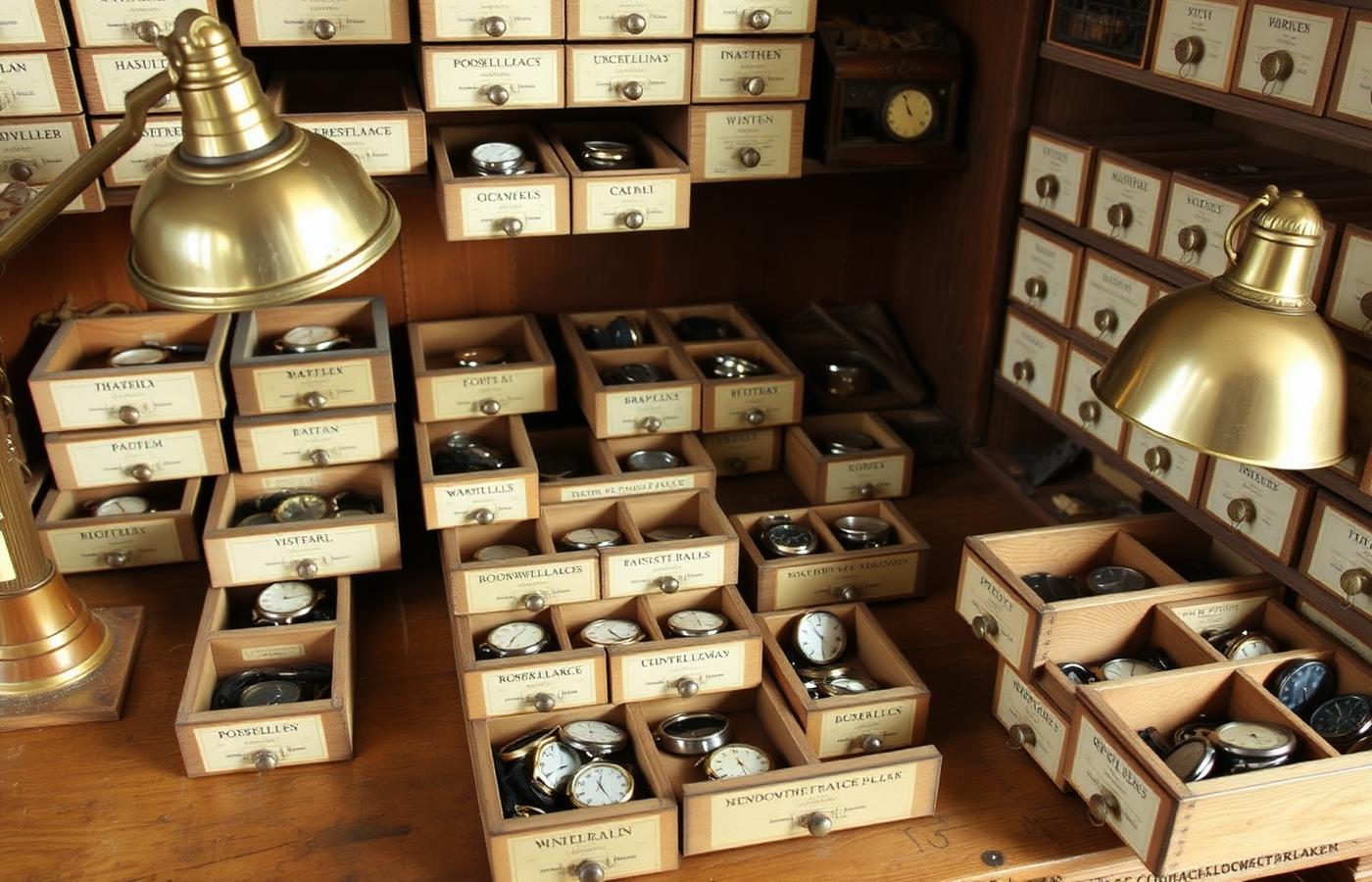
The drawers are labelled in pencil, in a hand that has not changed in four decades, and none of the labels name a brand. They read instead: worn barrel arbors, magnetised hairsprings, incorrect service hands, refinished dials sold as original, keyless works failures. This is a collection organised by pathology. Its owner spent forty-one years as a trade watchmaker in a small city workshop, and over that period he set aside, purchased from clients or accepted in lieu of payment one representative example of every recurring mechanical failure and every recurring authenticity problem he encountered. The result is not a collection in the conventional sense. It is a teaching instrument that happens to be made of watches.
How the Archive Formed
He began the practice in 1971, three years into independent trade, after a client dispute over a service dial that he could not adequately explain at the time. He resolved to keep physical comparison examples so that future explanations could be demonstrated rather than asserted. The first drawer held six dials. The habit expanded from there without ever becoming a deliberate collecting project.
Through the 1970s and 1980s, mechanical watches arrived at the bench in volumes that are difficult to imagine now, and many were abandoned by owners who considered a quartz replacement more sensible than a service bill. He kept the ones that illustrated something. Everything else was returned, sold on or scrapped for parts.
What the Organisation Teaches
Because the archive is arranged by failure mode rather than by brand, it demonstrates something that brand-organised collections cannot: that the same problems recur across manufacturers, price points and decades, and that the diagnostic signatures are consistent. The drawer of magnetised hairsprings contains examples from eleven brands spanning thirty years, and under a loupe they all look the same.
For authentication study the effect is even more striking. His drawer of refinished dials, each paired with an original example of the same reference, compresses years of comparative experience into an afternoon of looking. Several regional collectors now visit specifically to spend time with that drawer before making significant purchases.
The Ledgers
Alongside the watches sit the service ledgers: forty-one years of dated entries recording reference numbers, movement serials, work performed and parts fitted. He has redacted client identities but retained the technical records, and they constitute a longitudinal dataset on mid-century service practice that essentially does not exist elsewhere in accessible form.
The ledgers document, for instance, exactly when generic replacement hands began appearing in his parts supply, and which reference families were most affected. That kind of information reframes debates about originality that are usually conducted on the basis of assumption.
Where It Goes Next
He has arranged for the whole archive, watches and ledgers together, to pass to a regional horological training school on his death, with a condition that it remain intact and accessible to students. Two auction specialists have approached him about dispersal; he declined both without much deliberation.
Asked whether he regarded the collection as valuable, he answered that the individual watches were mostly ordinary and that the value was entirely in the arrangement. Break it into lots and you have three hundred and forty modest vintage watches. Keep it together and you have forty years of diagnostic experience that a student can walk through in a week.
Closing Perspective
The most instructive private collections are rarely the most expensive ones. This archive contains almost nothing that would lead an auction catalogue, and it teaches more about vintage watches than most collections assembled at fifty times the cost.
Background Knowledge
Trade watchmakers who worked through the quartz transition handled enormous volumes of mechanical watches at a time when those pieces carried little collector value. A minority kept systematic records, and a smaller minority kept the watches.
Extended Notes
Collections assembled by working watchmakers tend to be organised around mechanical taxonomy rather than market taxonomy, which makes them unusually useful reference material for authentication and service study.
Frequently Asked
- How large is the archive?
- Roughly three hundred and forty complete watches and several thousand loose movements, organised across forty-one labelled drawer units.
- Is any of it for sale?
- He has declined all offers to date and has arranged for the archive to pass to a regional horological school.
- What is the most valuable piece?
- He declined to estimate and considers the question beside the point, noting that the drawer of failed mainsprings has taught more people more than any single watch in the collection.
Collector Value Note
Reference archives of this kind rarely command prices reflecting their instructional value, because the market prices individual watches rather than the coherence of a collection. That gap is an opportunity for institutional buyers.
Sources & Further Reading
- Interview conducted at the collector's home workshop over two sessions in May 2026
- Review of the subject's service ledgers covering 1968 to 2009, with identifying client details withheld at his request
This article is editorial commentary. It does not constitute authentication, valuation or investment advice.
Related Reading
More From the Register
Collector Profiles
Profile: A Berlin Collector Who Built an Archive at the Sunday Flea Market
Collector Profiles
Beyond the Famous Names: Five Obscure Swiss Manufactures Worth Following
Collector Profiles